The blocklist is the list of companies and people Ken must never contact, in campaigns, 1:1 plans, replies and LinkedIn. Add a domain and Ken skips everyone at that company. Add an email and Ken skips that one person. You can add entries by hand, upload a CSV, or let your CRM add them. Set it up before your first send, because one email to a current customer or an open deal costs more than any campaign earns.
Before you start
- You need the workspace settings permission. Admins and Editors have it.
- Gather the domains of your customers, partners, competitors and open deals, and any people who asked you not to contact them. Your CRM is the best source: export them to a CSV, or connect your CRM and let it add them.
Block a domain or an email
- Press G then , to open Settings, then click Blocklist under Workspace. The page opens on the Entries tab.
- Click the field that says "Add a domain or email, like acme.com", and type a domain, such as
kestrellabs.com, or one person's email. - Optionally, give a reason in the field next to it, such as Current client, Competitor, Partner or Open deal. Pick a suggestion or type your own.
- Click Add, or press ↵.
Kenso confirms with "Ken will not contact kestrellabs.com", and the entry appears at the top of the list with its reason, where it came from and the date.
A few rules for entries:
- A domain covers its subdomains. Blocking
stackpoint.ioalso blocksmail.stackpoint.ioand anyone with an email at either one. It doesn't work the other way: blockingeu.stackpoint.ioleavesstackpoint.ioopen. - Paste a website if that is easier. Kenso keeps only the domain, so
https://www.stackpoint.io/pricingbecomesstackpoint.io. - No wildcards. Entries like
*.govdon't work. Add each domain. - Each entry once. If it is already on the list, Kenso says so, for example "stackpoint.io is already blocked".
To add or change a reason later, click the reason on the entry's row, type and press ↵. To take an entry off, click the x at the end of its row. Kenso confirms with "Removed" and the entry. Ken can contact that company or person again from then on, so remove entries with care.
Upload a CSV
Use Upload CSV at the top of the page to block a whole list at once, such as your customers or a competitor list. A file can have up to 50,000 rows and 10 MB, with any columns.
- Click Upload CSV, then drop the file in the box or click choose one.
- Columns. For each column, pick what it holds under Use as: Email, Domain or website, Reason or Skip. Kenso guesses from the headers, so check its picks against the first rows it shows.
- Under Reason, choose One reason for every row, or take the reason from your reason column, with a reason for empty cells. Click Preview.
- Preview. Kenso counts the new entries, the ones already blocked, values that appear twice in the file and the rows it skips, and lists what will be added. Nothing is written yet. Click Block and the number, such as Block 240.
- Done. Kenso shows what it added and what it left out. Click Done.
Kenso skips a row with no email or domain, like a company name alone. It also skips free email domains, such as gmail.com, and profile links, such as a LinkedIn URL, so one row never blocks a whole mail provider or social site. To block one person with a free email address, keep their email column as Email.
The Uploads tab lists the files you uploaded since you opened the page. To take back exactly the entries a file added, click its Undo button, such as Undo 240 entries, then click it again where it now says Remove 240 entries. Keep the page open until it finishes. Kenso keeps no record of an upload once you leave the page, so undo a wrong file before you move on.
Block from your CRM
When your CRM is connected, it adds to the blocklist for you once you turn on the Opt-outs switch on your CRM's page:
- Opt-outs. A contact who opted out or is marked do not contact in your CRM goes on the blocklist.
- Customers. With Add customers to the blocklist also on (it is on by default), the domain of a company marked customer in your CRM, or of a company with a won deal, goes on the blocklist with a reason such as "Customer in Close". If the company is in Accounts, Kenso also marks that account a customer.
Kenso does not take an opt-out or a customer domain off when the record changes or is deleted in your CRM. Remove it by hand if you want to contact that company or person again. A row that shows Customer account comes from an account marked customer: it has a lock instead of the x, and you unblock it by clearing the account's Customer flag in Accounts. Click From CRM above the list to see these rows. To connect your CRM, see Connect your CRM.
Some workspaces also have a CRM rules tab. A rule blocks every account at the pipeline stages you pick, and keeps the list in step as accounts move:
- Open the CRM rules tab and click Add rule.
- Give the rule a name, pick the stages, and fill in Reason on each entry. Where your workspace offers it, a rule can also use a list or lifecycle stage from your connected CRM.
- To unblock accounts some time after their deal closed, turn on Take accounts off after a set time and enter the days.
- Check Who matches, then click Save. Saving turns the rule on.
Turn a rule off with its switch, and its entries leave the blocklist.
Find an entry
Search by domain, email or reason in the box at the top of the Entries tab. The filters under it show All, Emails, Domains and No reason, each with its count. Once a customer account or a CRM rule has added entries, From CRM shows those.
What the blocklist stops
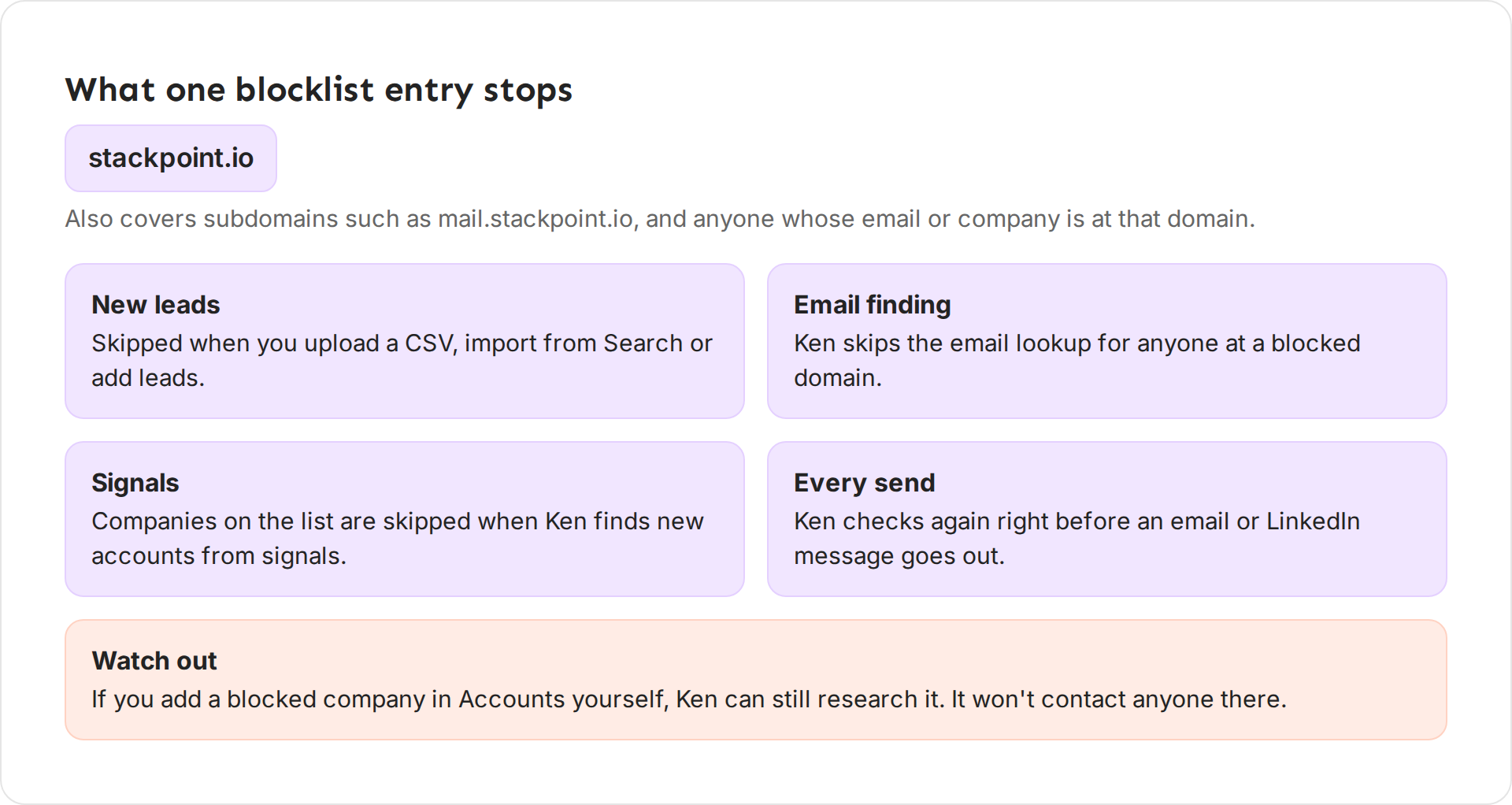
- New leads. When you upload a CSV, import from Search or add leads, Kenso skips anyone at a blocked domain or with a blocked email.
- Email finding. Ken doesn't look up emails for anyone at a blocked domain, so you spend no credits on them. Workflows also check the blocklist before every step.
- Signals. When Ken finds new accounts from signals, it skips companies on the blocklist.
- Every send. Kenso checks the blocklist again right before each email and LinkedIn message goes out. If you block a company after its people are in a campaign, the next touch to them doesn't go out.
- Replies. When you reply from the Inbox to a blocked email or domain, Kenso asks first with "Send to a suppressed contact?". Click Cancel to keep the reply, or Send anyway if you mean to write to them. Ken's autonomous replies never go to a blocked contact.
Add your own company's domains
Kenso blocks your own domains for you once they are on the Company page.
- In Settings, click Company under Workspace.
- Under Websites and domains, click Add domain, type the domain and click Add. Kenso confirms with "Added" and the domain.
List your company's own websites and email domains, not your cold sending domains. Ken never cold emails people at these domains, even when they are in an imported file. They show on the Blocklist page with a lock, so you don't need to add them there. Remove a domain on the Company page and Kenso takes it off the blocklist too.
Unsubscribes are kept for you
When someone clicks the unsubscribe link in your email, or replies asking you to stop, Kenso adds their email to the blocklist. You don't need to do anything. Don't remove these entries. Anti-spam laws require you to honor an unsubscribe, and ignoring one hurts your sending reputation.
Best practice: block before your first send
Kenso's own outbound team imports exclusion lists before a campaign launches, never after a complaint. Before your first send, block:
- Current customers. Cold email to a customer looks careless and can start a churn conversation.
- Open deals. Your sales team is already talking to them. Block the company domain, not just the contact, so a teammate at the same company isn't pitched.
- Partners and resellers.
- Competitors. A pitch to a competitor wastes a send and shows them your playbook.
- People who asked not to be contacted, from your CRM or an old tool.
Give each entry a reason, so anyone can tell later why it is there. Check at both levels: block the domain for whole companies and the email for single people, such as a former customer's champion who moved to a new company you do want to reach.
Review the list each month. Add new customers and new open deals, and take off companies that are prospects again, such as a lost deal you want to try in a new quarter. No reason shows the entries nobody explained yet.
If something goes wrong
- "Kenso says the entry is not valid." Check for typos and wildcards. Use a plain domain like
acme.comor a full email. - "Someone at a blocked company is still in my campaign." They stay in the list, but Kenso checks the blocklist before every send and doesn't send to them.
- "A blocked company still shows in Accounts." It was added by hand, so Ken researched it. Remove the account.
- "I have hundreds of domains to block." Use Upload CSV. One file takes up to 50,000 rows.
- "My upload skipped rows." Kenso skips rows with no email or domain, free email domains and profile links. The Done step lists what it left out.
- "I can't remove an entry. It shows a lock." A CRM rule, a customer account or your own domains on the Company page added it. Hover the lock to see where to change it.
- "Send to a suppressed contact?" You are replying from the Inbox to someone on the blocklist. Click Cancel, or Send anyway if they wrote to you and you mean to answer.
- "I can't add or remove entries." You need the workspace settings permission. Ask an admin.
Next: Connect your CRM, Choose your audience and split it into segments or Add target accounts and let Ken research them.