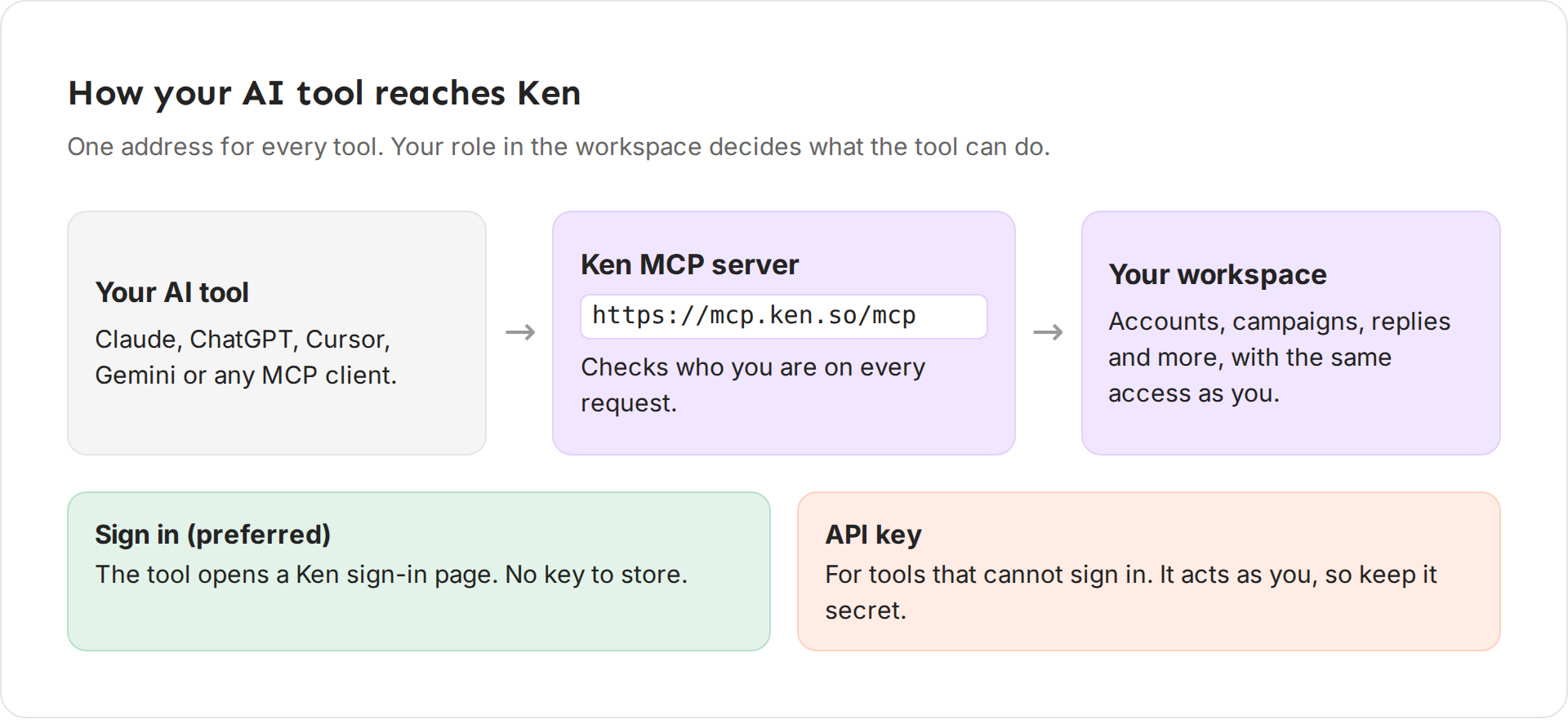
You can work with Kenso from the AI tool you already use, such as Claude or ChatGPT. The tool connects to Kenso's MCP server and works with your role. It can do most of what you can do in Kenso, and a few admin areas stay off limits. You can then ask it about your accounts, replies and campaigns, have it draft work for you, or have it approve what waits for you in Kenso.
Before you start
- You need a Kenso account that is a member of the workspace.
- Your AI tool must support remote MCP servers. Claude, Claude Code, ChatGPT, Cursor, Windsurf, VS Code, the Gemini CLI and Grok do.
Copy the server URL
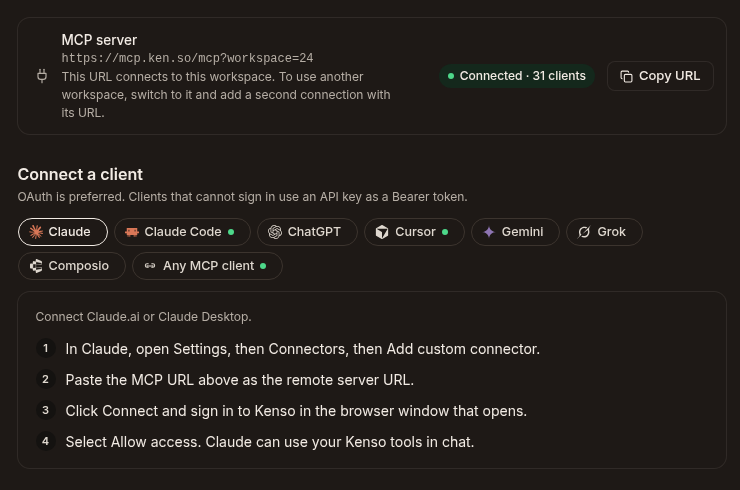
- Press G then , to open Settings, then click MCP and AI agents under Integrations. You can also open All integrations and click your tool's card under AI agents (or Any MCP client).
- On the MCP server card, click Copy URL. You see Copied the MCP URL.
- Under Connect a client, pick your tool: Claude, Claude Code, ChatGPT, Cursor, Gemini, Grok, Composio or Any MCP client. Its steps show below.
The URL ends in ?workspace= and this workspace's number, so your tool works in this workspace. The page says "This URL connects to this workspace." To use another workspace too, switch to it and add a second connection with its URL.
Connect your tool
Signing in is the preferred way. Your tool opens a Kenso sign-in page, and you never handle a key. The steps below are the ones the page shows for each tool.
Claude
- In Claude, open Settings, then Connectors, then Add custom connector.
- Paste the MCP URL as the remote server URL.
- Click Connect and sign in to Kenso in the browser window that opens.
- Select Allow access. Claude can now use your Kenso tools in chat.
Claude Code
Run the command the page shows in a terminal. It looks like this, with your workspace's URL:
claude mcp add --transport http kenso "https://mcp.ken.so/mcp?workspace=42"
The first time you use it, sign in to Kenso in the browser. Click the copy button next to the command to copy it with your URL in it.
ChatGPT
- On the ChatGPT tab, click Open Kenso in ChatGPT, then select Install plugin. Log in to ChatGPT first if it asks.
- When ChatGPT asks, sign in with your Kenso account and select Allow access.
- Ask Kenso about your campaigns in any chat. If you belong to several workspaces, tell ChatGPT which one to use.
Cursor, Gemini, Grok and other tools
Add a remote MCP server that uses streamable HTTP, and paste the MCP URL. When the tool asks you to sign in, complete the sign-in. If it cannot, use an API key as its Bearer token (see the next section). The tab for your tool on the page has its exact steps.
Once a tool has called Kenso, the MCP server card counts it as connected, and Recent calls lists what it did.
Create an API key for tools that cannot sign in
Use an API key only when your tool cannot complete the sign-in, or for a script or scheduled job. For a scheduled job, send the key in a request header where your tool takes one.
- Press G then , to open Settings, then click API keys under Integrations.
- Click Create key at the top right. Kenso adds a key named New key and a number, with no expiry date.
- Under Copy this key now, click Copy, then paste the key into your tool as the Bearer token right away.
- Close the box with the X. After that, you cannot see the key again.
A Kenso key starts with ken_. The list shows each key's name, the start of the key, when it was created and when it was last used.
What your AI tool can do
Your AI tool works with your role. A connection works in one workspace: the one in its URL. Add Kenso once per workspace, each with the URL from that workspace's MCP and AI agents page. A call that names another workspace is refused. Kenso checks your role on every request, so if an admin changes your role or removes you, the tool's access changes at once.
| Area | Examples of what the tool can reach |
|---|---|
| Accounts | Accounts, people, the buying committee, opportunities, touches |
| Campaigns | Campaigns, leads, segments, sequences, results |
| Inbox | Threads and replies |
| Today and meetings | What needs you, meetings, booking links |
| Search and Knowledge | Lead search, your Knowledge files and skills |
| Delivery | Domains and inboxes |
Some things stay out of reach for every AI tool, whatever your role: billing, API keys and webhooks, member and workspace administration, and audit logs.
Two rules always hold:
- A tool approves only as you, and only when you ask. It can approve or skip what waits for you in Today, such as a touch, under the same rules as you: a touch only when it sends from your own inbox or LinkedIn, and only with the Approve and send touches permission. See What Ken does on its own.
- A tool changes your contact limits only with your role. It can make a limit or guardrail stricter or looser only when your role can change workspace settings.
To see what runs on its own and what waits for your approval, click Open permissions under Set approval rules on the same page. It opens Settings › Ken agent.
What to ask
Popular prompts on the page lists questions that work in any workspace, each with a copy button. For Claude, ChatGPT, Cursor and Grok, the arrow next to a prompt opens it in a new chat. More ideas:
- "Which of my Tier 1 accounts have had no touch in the last 3 weeks?"
- "Summarize the replies I got yesterday and draft an answer to the two most interested ones."
- "What changed at Halcyon Health this month? Then draft a touch to Priya Nair for my approval."
- "How did my campaigns do in the last 14 days? Show replies by step."
- "Who is on my calendar this week, and which of those meetings are with accounts?"
For how to phrase requests well, see Get better answers from Ken.
Keep your keys safe
- Prefer signing in. There is no key to store, so there is nothing to leak. A scheduled agent is the exception: a sign-in can expire and stop the schedule without warning, so use a key in a request header where your tool takes one.
- Treat a key like a password. It acts as you, with your role. Never paste it into a chat, a shared doc or a code repository.
- One key per tool. Create a separate key for each tool and note which key starts with which characters. If one leaks, you revoke only that one.
- Revoke keys you no longer use. On API keys, click Revoke on the key's row. Kenso confirms with "Revoked" and the key's name. Any tool that uses the key stops working.
- Keep your tool's confirm step on. An admin's tool can make real changes, such as pausing a campaign. Have the tool ask you before any change.
If something goes wrong
The tool says it cannot connect. Copy the URL again from Settings › MCP and AI agents, and check that the tool uses streamable HTTP, not a local server.
The sign-in window never opens. Your tool may not support signing in to a remote server. Use an API key as the Bearer token instead.
Every call says the connection is not pinned to a workspace. The URL in your tool doesn't name a workspace. Copy the URL from MCP and AI agents in the workspace you want and connect again.
The tool can't approve a touch. The touch sends from someone else's inbox or LinkedIn, or your role doesn't have the Approve and send touches permission. Approve it in Today, or ask the sender to.
I lost my key. You cannot see it again. Create a new key, update your tool, and revoke the old one.
The tool can read but not change anything. Your role in that workspace can only view. Ask a workspace admin to change it.
Next: What Ken does on its own or Invite your team and set roles.