Your Kenso account holds your inboxes, your replies and your prospects' data, so a stolen password should never be enough to get in. Everything about how you sign in is on one page: your password, two-factor authentication, passkeys, connected logins and the devices where you are signed in.
Open your security settings
-
Press G then , to open Settings, or click the gear next to your name.
-
Click Security under Account.
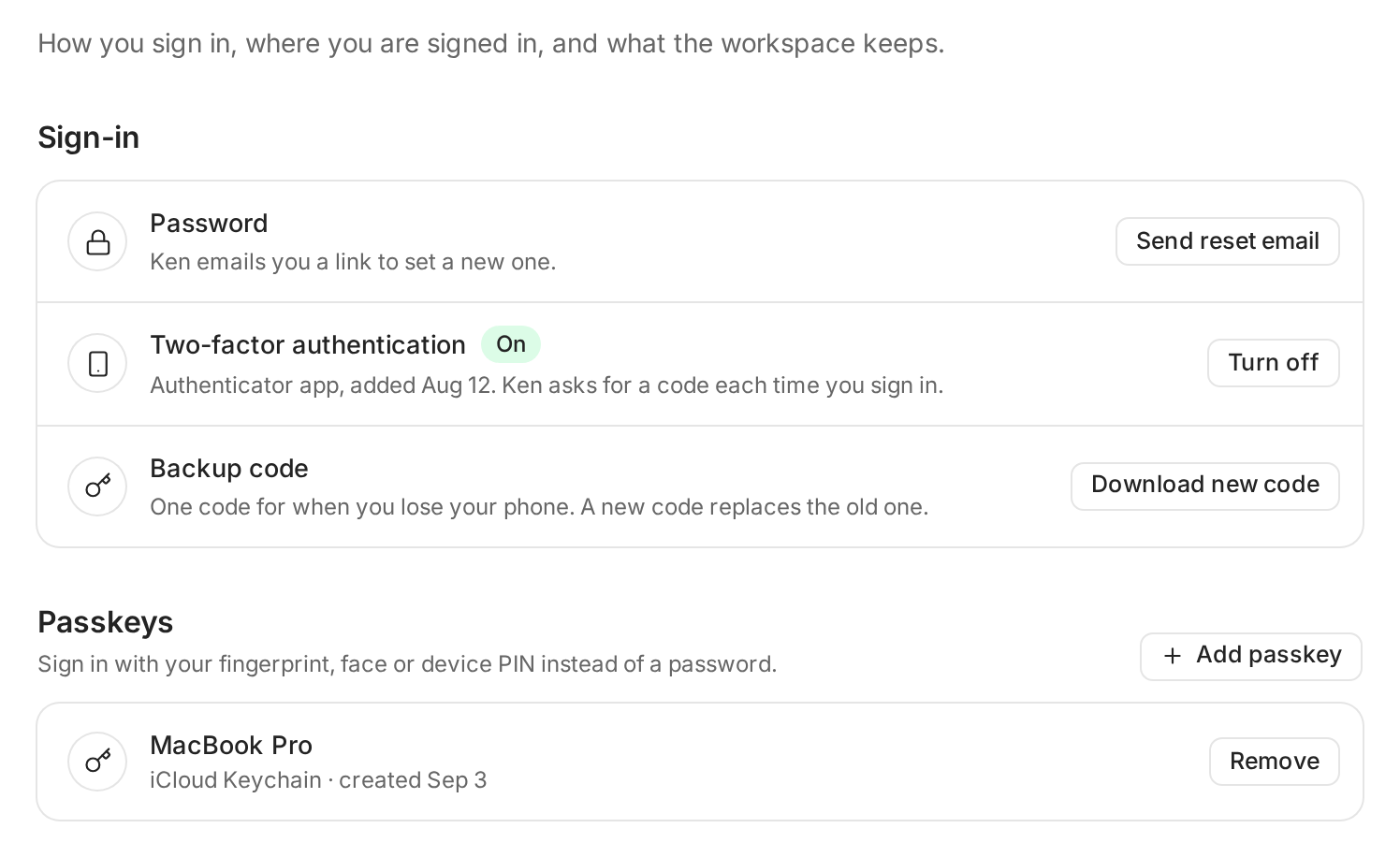
Sign-in and Passkeys are at the top of the Security page.
These settings belong to you, not the workspace. They apply to every Kenso workspace you are in.
Reset your password
- Under Sign-in, click Send reset email on the Password row.
- The row changes to "Reset link sent to" and your email. Open the email from Kenso and follow the link to set a new password.
- If the email doesn't come, check spam, then click Send again.
If you sign in with Google, LinkedIn or Microsoft and have no Kenso password, the row says so instead.
Turn on two-factor authentication
With two-factor authentication on, Kenso asks for a code from your phone each time you sign in. You need an authenticator app on your phone.
- On the Two-factor authentication row, click Turn on. If Kenso says "Sign in again to set up two-factor authentication.", click Sign in on that message. Kenso brings you back here.
- Scan the QR code with your authenticator app, or type the secret shown under it into the app.
- Type the 6-digit code the app shows and click Verify.
- Kenso shows your backup code: "Save this backup code now: Kenso shows it only once." Click Copy or Download and keep it in your password manager, then click Done.
The row now shows On with "Authenticator app. Kenso asks for a code each time you sign in."
To turn it off, click Turn off, then Turn off again to confirm. Kenso stops asking for a code, and your backup code stops working.
Keep a backup code
The backup code gets you in once if you lose your phone. To get a new one, click Download new code on the Backup code row. The new code replaces the old one, which stops working right away, so save it before you leave the page.
Get codes by email too
Once your authenticator app is set up, an Email codes row shows under it. Click Add, type the 6-digit code Kenso emails you, and click Verify. Kenso can then email you a sign-in code when your app isn't at hand. Email codes work next to the app, never on their own. To stop them, click Remove on the row and confirm.
Add a passkey
A passkey lets you sign in with your fingerprint, face or device PIN instead of typing a password. There is nothing to type, and a passkey works only on Kenso's real sign-in page, so a fake page can't steal it.
- Under Passkeys, click Add passkey.
- Kenso opens a password sign-in. Sign in.
- When your browser offers to save a passkey, save it. Kenso brings you back to the Security page.
Kenso then says Passkey saved, and the passkey shows in the list, named after the device or password manager that holds it. Add one on each computer you use every day. To remove one, click Remove on its row.
Connect another way to sign in
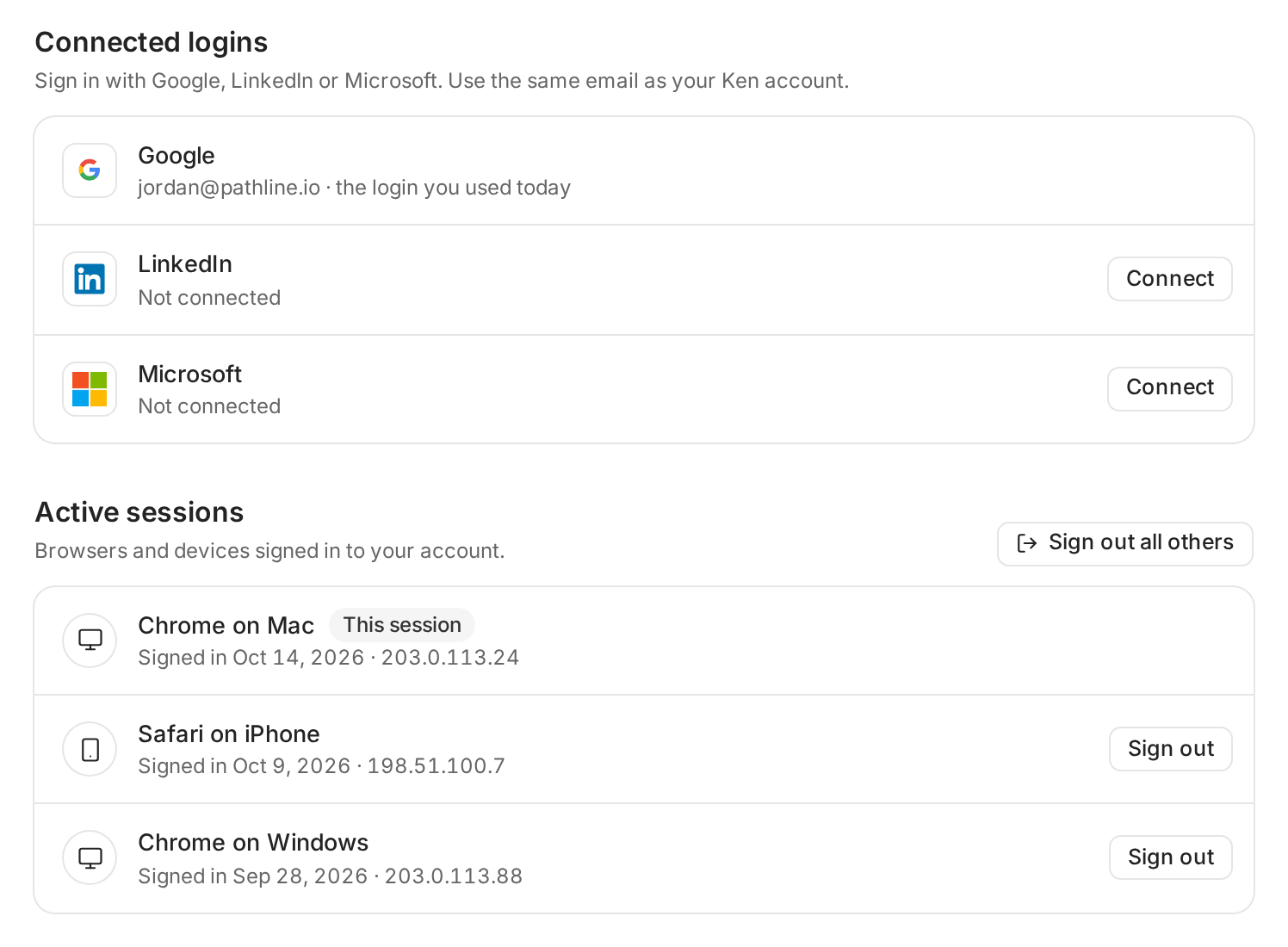
Under Connected logins, click Connect next to Google, LinkedIn or Microsoft, then sign in to that account. Back on the page, Kenso asks you to confirm, for example "Connect Google as [email protected]?". A login you connect signs in to this account, even with another email. After that, the matching button on the Kenso sign-in page signs you in. To stop using one, click Disconnect on its row. If Microsoft says "Microsoft work logins can't be connected yet.", use Google or LinkedIn.
Sign out other devices
Active sessions lists every browser and device signed in to your account. Your current one is marked This session.
- To sign out one device, click Sign out on its row.
- To sign out everywhere except here, click Sign out all others.
A signed out device can't renew its sign-in, but access it already has can last up to 24 hours. If you think someone else has your password, reset it too.
Best practice for your team
- Turn on two-factor for everyone, admins first. An admin account can change billing, members and integrations, so it needs more than a password.
- Add a passkey on every computer you use daily. You sign in faster, and a fake sign-in page can't capture it.
- Store the backup code in your password manager, not in the same phone as the authenticator app.
- Use your work Google or Microsoft login. When you sign in with that button, your company's own sign-in checks run too, such as its two-factor rules.
- Check Active sessions after travel or a lost device. Sign out anything you don't recognize, then reset your password.
- Remove people the day they leave. Deactivate them in Settings › Members. See Invite your team and set roles.
If something goes wrong
- "That code didn't match." Codes change every 30 seconds. Type the newest one. If it keeps failing, set your phone's clock to update automatically.
- "This setup expired." You waited too long to scan. Click Turn on again to get a new QR code.
- "Too many attempts." Wait a few minutes and try again.
- "Sign in again to set up two-factor authentication." Kenso needs a fresh sign-in before it changes two-factor. Click Sign in on the message, then try once more.
- "I lost my phone." Sign in with your backup code, then turn two-factor off and on again with your new phone. Save the new backup code.
- "I lost my phone and my backup code." If you added email codes, sign in with a code from your email. If you connected a Google, LinkedIn or Microsoft login, sign in with that button. Then set up two-factor again at app.ken.so/settings/security. If neither works, write to [email protected] from the email on your Kenso account and ask for a two-factor reset. Before we reset it, we confirm it's you, either with another admin on your workspace or on a short call, so it can take a day. If neither is possible, we email you a notice and reset it 7 days later, unless you reply to stop it. After a reset, we let the other admins of your workspace know.
- "No new passkey was saved." Your browser didn't save a passkey during the sign-in. Click Add passkey again and save the passkey when your browser offers it.
- "Couldn't connect that login." Try again. Use an account with a verified email, and confirm within 5 minutes of signing in to it.
- "Passkeys need a password login." You sign in only with Google, LinkedIn or Microsoft, so Add passkey doesn't show. Passkeys work for accounts that sign in with a password.
- "Some sessions are still signed in." Wait a minute, then click Sign out all others again.
Next: Keep companies and people off your lists or Invite your team and set roles.