Kenso can run email finding and AI work on your own accounts with outside providers. Kenso still does the work, but anything done with your keys costs 0 Kenso credits, and your provider bills you directly. This pays off when you find thousands of emails a month or already pay for an AI plan.
Before you start
- You need a role that can change integrations, such as workspace admin.
- Get an API key from your account with the provider. Check that the account has credits or a paid plan.
Each provider is a card in Settings › All integrations:
| Section | Providers | What runs on your key |
|---|---|---|
| Data enrichment | Email finders such as Prospeo, Findymail and LeadMagic | Finding and verifying work emails for your leads |
| AI models | Anthropic and OpenRouter | Research, qualification and writing |
On Kenso's keys, each valid email costs 1 credit ($0.02) and AI work costs the normal credit rates. See How credits work for the full table.
Add a key
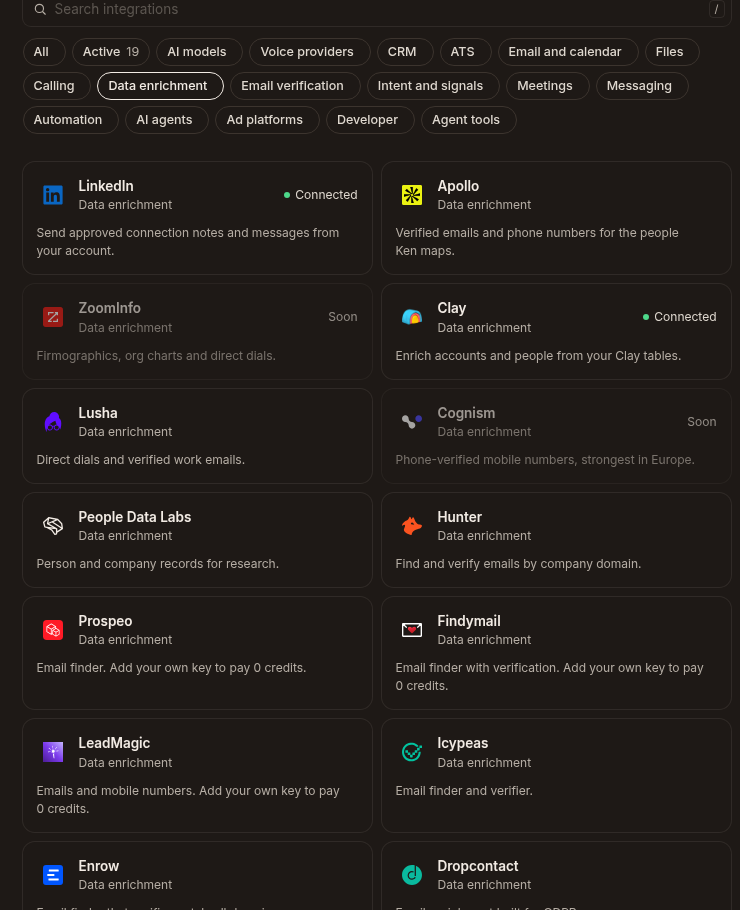
- Press G then , to open Settings, then click All integrations under Integrations.
- Click Data enrichment or AI models above the cards, or type the provider's name in Search integrations.
- Click the provider's card. Its page opens.
- Click Connect at the top right.
- Paste your API key and click Save. Kenso checks the key with the provider before it saves it.
- Kenso confirms with Connected and the provider's name. The card now counts under Active.
Kenso uses the key only in this workspace. If you run more than one workspace, add the key in each one.
Email finder keys work as one pool
Add more than one email finder and Kenso treats them as a single pool, so one fallback switch covers all of them at once (see below).
AI keys
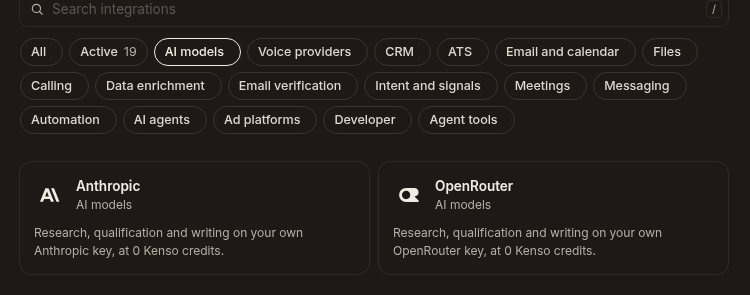
With an AI key connected, research, qualification and writing for your campaigns run on your key at 0 Kenso credits. Until you add one, Kenso runs its default model for that work and charges credits.
Choose what happens when a key fails
Keys stop working. A provider account runs out of credits, a key gets revoked, or a provider can't find a person. The Kenso fallback switch on a connected provider's page decides what Kenso does then.
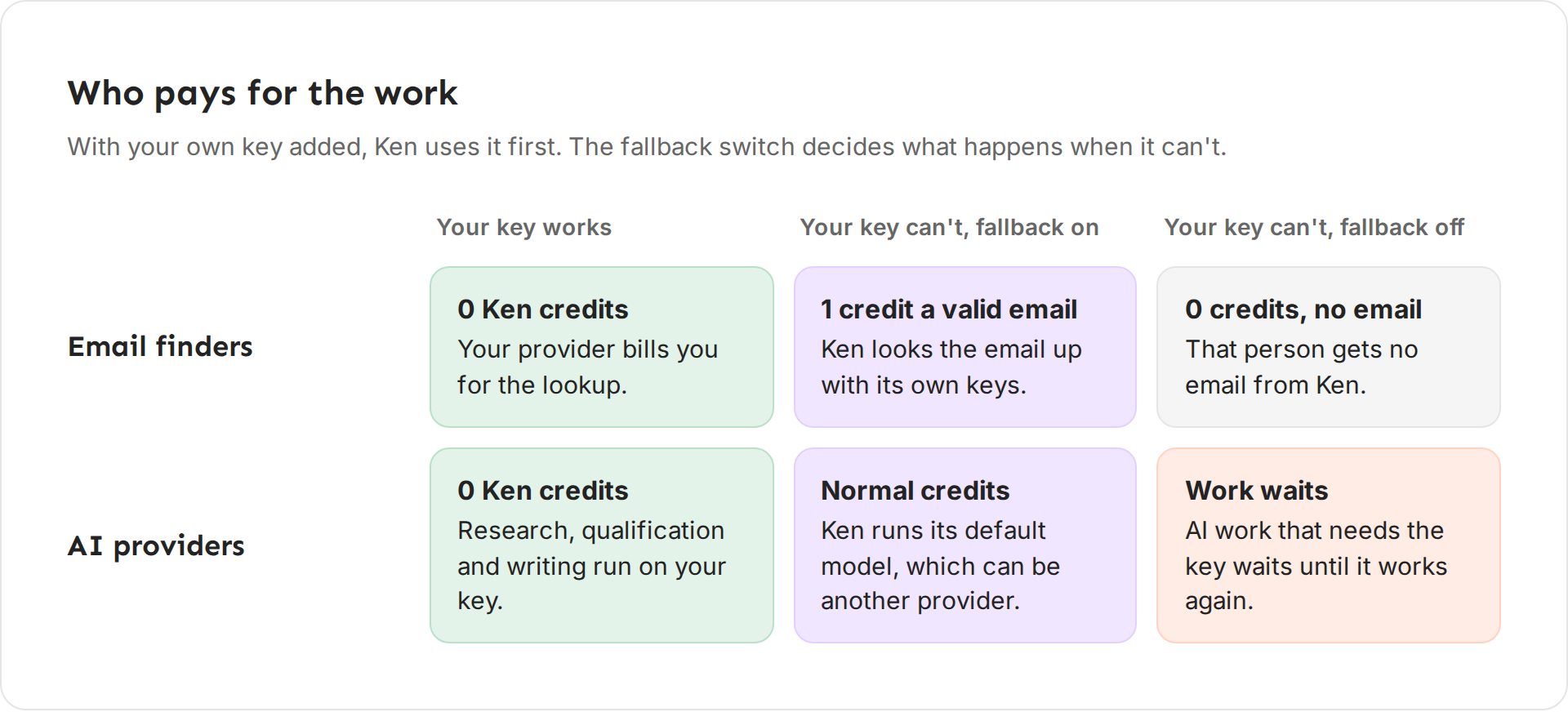
- Email finders. On any connected finder's page, Use Kenso's keys when yours fail is one switch for all your finder keys. On, Kenso looks the email up with its own keys and charges credits at the normal rate. Off, Kenso only uses your keys, and a person they can't cover gets no email and costs no credits.
- AI models. On each connected AI key's page, Use Kenso's key when yours fails works the same way for that key. On, Kenso runs its default model and charges credits, and that model can be from another provider. Off, AI work that needs the key waits until the key works again.
To change one:
- Open the connected provider's card in Settings › All integrations.
- Under Kenso fallback, turn the switch off or on. Kenso confirms, for example "Kenso fallback for email finders is off", and the text under the switch changes.
Replace or remove a key
- Replace. Remove the key, then connect again with the new key. Kenso checks it the same way as the first one.
- Remove. On the provider's page, click Disconnect at the top right, then Disconnect again to confirm. Kenso deletes the stored key and confirms with "Disconnected" and the provider's name. From then on, that work runs on Kenso's keys and costs credits again, unless fallback is off.
Keep your keys safe
- Kenso never shows a saved key again. Nobody in your workspace can copy a key back out of Kenso.
- Keys are used only in the workspace where you added them.
- Use a dedicated key for Kenso. Most providers let you create more than one key. A separate key lets you see Kenso's usage in your provider account and revoke it without breaking your other tools.
- Set a spending cap at the provider if it offers one. When your account hits the cap, Kenso treats the key as failed and follows your fallback switch.
- Rotate keys when someone leaves. If a person who had access to the raw key leaves your company, create a new key at the provider, add it in Kenso, then revoke the old one.
If something goes wrong
- "That key didn't work: Findymail rejected it." The provider refused it, and Kenso didn't save it. Copy the key again with no spaces before or after it, check that it is active in your provider account, and add it again.
- "Saved. Your Findymail account is out of credits." Kenso saved the key, but your provider account is empty. Top it up at the provider. Until then, Kenso uses its own keys if fallback is on.
- "I'm still being charged credits for emails." Your finders couldn't cover those people, and fallback is on. Kenso's keys found them at 1 credit each. Turn off Use Kenso's keys when yours fail if you don't want that.
- "Kenso won't save or remove my key." Your role can't change integrations. Ask a workspace admin to do it for you.
Next: How credits work, Get more from your credits or Invite your team and set roles.